


Picture this: it’s 11:47 PM, and your next EW is due at midnight. You’re frantically typing away, fueled by a potent mix of panic and a fourth cup of a caffeinated drink which you swore would be your last. Sound familiar? Well, if so, welcome to the not-so-exclusive club of procrastinators – a place where your future self is perpetually more responsible than the present you. But why do we repeatedly fail fall into this time-wasting trap, despite swearing “never again” after each caffeine-fueled, last-minute marathon? This is just what I intend to answer. Not only that but also what practical strategies are being explored to finally break this cycle – as, let’s face it, we could all do well with this advice.
No matter how well-organized or committed you are, chances are that you have found yourself frittering away hours on trivial pursuits (binging Netflix, for example) when you should have been spending all that time on work or school-related projects. It seems a ubiquitous quality of our generation; iPhones, iPads and computers constantly distract and detract from social engagement and focus as we are often less motivated than we would be if these items didn’t exist.
However, procrastination is not exclusively a modern problem. From the dawn of civilization to the digital age, this timeless tendency has plagued humans, making us all, inherently, masters of delay. The Greeks even had a word for it – akrasia, the state of acting against one’s better judgement. It’s as if a mischievous inner voice has forever tempted humans with short-term comfort, pulling us away from our long-term goals.
According to Joseph Ferrari, a professor of psychology at DePaul University of Chicago, around 20% of U.S. adults are chronic procrastinators – the worst form of this irrational delaying! They consistently avoid tasks and responsibilities, even when doing so can possibly result in negative consequences. It becomes a way of life for them; and they may become depressed, lonely, or even begin to lack the will to live. However, despite these visible consequences, procrastination remains a compulsive mood and they are forever unable to resolve such an attitude. It begs the question of why? How can we eliminate the things which force us to procrastinate in the first place?
Well, this is a good time to bring some science into our discussion. Behavioral psychology research has revealed a phenomenon known as “time inconsistency”, which refers to the tendency of human beings to value immediate rewards more highly than future ones. Some even refer to this as forming “present biases”.
A good way of understanding this is to imagine two different persons: (i) your Present Self and (ii) your Future Self. When you set goals for yourself – finishing a task or revising for a trial – you are making plans for your Future Self; and thus, your Future Self values taking actions with long-term benefits. Yet, while your Future Self can set goals, only the Present Self can take action. So, when the time comes to decide, you are no longer making a choice for your Future Self, but are in the present moment. In this way, the Present Self really likes instant gratification, not long-term payoff.
On top of this, researchers have identified some major cognitive distortions that lead to academic procrastination. They state that students tend to: (i) overestimate how much time they have left to perform tasks; (ii) overestimate how motivated they will be in the future; (iii) underestimate how long certain activities will take to complete; and (iv) mistakenly assume they need to be in the right frame of mind to work on a project. For these reasons, people never get the task done, at the right time, and this can be incredibly stressful.
It’s worth noting the impact of certain psychological disorders on procrastination as well. Attention-deficit/hyperactivity disorder (ADHD) and obsessive-compulsive disorder (OCD) are major players in this delaying game. When you’re so distracted by outside stimuli, as well as internal thoughts, (as is with ADHD), tasks can become incredibly difficult to start and get engaged in. OCD is linked to maladaptive perfectionism, which evokes fears over making mistakes and worrying over other expectations of oneself. This happens to such an extent that they always doubt if they’re doing something correctly, thereby waiting (almost perpetually) for the right moment to start doing the task at hand. People with OCD also often have a propensity toward indecision, causing them to always procrastinate instead of simply being decisive.
Other factors which significantly contribute to procrastinating include task aversiveness, low energy, low capacity for self-control, problematic environments, inertia and expected effort (due to hard tasks). For those who continue to be influenced by such things, there is also a plethora of negative impacts. From higher levels of stress and illness, increased burdens on social relationships to resentment from friends, families, and fellow students, the consequences of procrastination are incredibly unappealing. So how can we avoid it?
Atop the basic things that are generically known as strategies to resolve any psychological issue, such as improving your environment, increasing your energy and making things easier to do, there are a multitude of more specific options you can take as well. The first option is to make the rewards of acting more immediate; the strategy of doing this is known as “temptation bundling”. Simply put, this mechanism suggests that you bundle a behavior that is good for you in the long run with a behavior that feels good in the short run.
A second option is very similar to the previous one in that you can make the consequences more immediate too. There are services like Stickk where you can place bets on doing important tasks. If you don’t do what you said you’ll do, then the money goes to a charity, and this is what incentivizes you to actually do something.
A third and final option is to design your future actions by means of an action plan. Psychologists call this tool a “commitment device” and it fundamentally functions like a to-do list. Through this technique, we can place emphasis on what we need to do and when; and we can push forward deadlines in this to-do list such that we stay productive, and the sense of urgency comes to us quicker.
To make these strategies more concrete, let’s look at a practical example. Imagine you struggle with exercising regularly. By using “temptation bundling”, you can pair your workouts with a favorite activity, such as only allowing yourself to watch a beloved TV show when on the treadmill, thereby creating a positive feedback loop. Once you’ve stablished this, you can then set tasks using the Stickk app (for example) so you now know there is a risk in failing to do this activity; and then, finally, you can make a to-do list. You can match the times you work out with the way your favorite TV show is programmed, but make sure this happens regularly – this shouldn’t just be another excuse out of for not exercising!
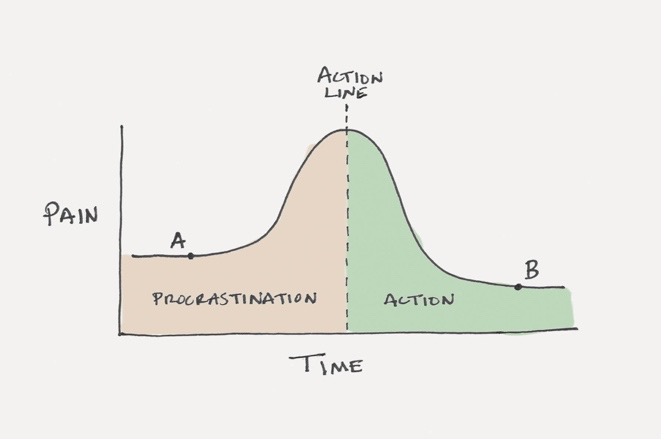
Hopefully, you now know a bit more about procrastination, its causes and its solutions. If you were to plot pain against time on a graph (as is shown above), you would notice that all your fears and stresses come when approaching doing the task but once you’ve crossed the ‘action line’, then your anxieties begin to subside. Overcoming procrastination is a difficult step but immensely rewarding. So, the next time your Firefly is bombarded with tasks or as trials draw nearer and nearer, devise a schedule or plan to get these things done more efficiently. And if that sounds boring, just remember that doing the task is much less stressful than just staying put, so do take action!

