


There are many models of addiction that have been developed over the years that attempt to explain the mechanisms behind addiction, and in this article I will be explaining their main ideas in simple terms.
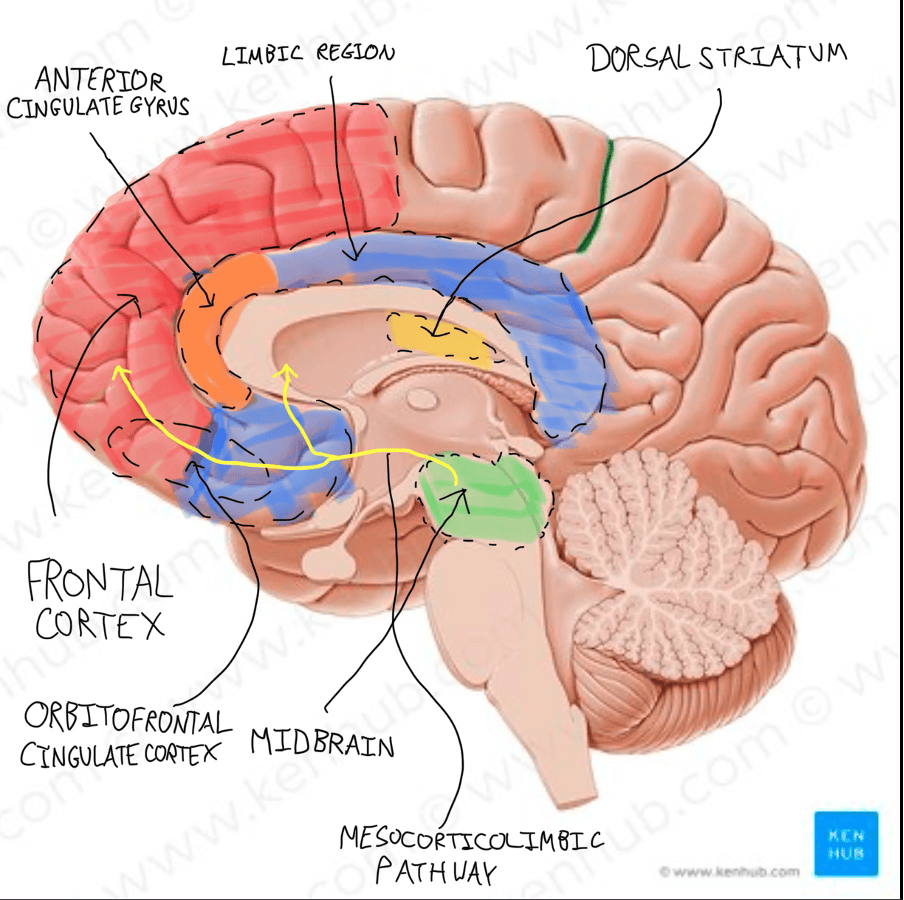
Incentive-sensitisation theory (first proposed by Robinson and Berridge in 1993) suggests that changes occur within the brain during initial use of a substance that lead to a hyper-sensitisation to the substance’s effects in the mesocorticolimbic regions (mid brain, frontal cortex).
This leads to increased incentive salience, which in short refers to how present and noticeable in your mind the need to do something is, such as the need to take a drug, and activity in the “wanting” part of the brain (dopamine and glutamate in corticolimbic regions), but not the “liking” part (dopaminergic, GABAergic, endocannabinoid and opioid signaling (sending of electrical signals in the brain) associated with the dorsal striatum).
The Allostatic model (Koob and Le Moal 1997) uses the opponent-process theory, which states that the expression of one emotion suppresses (cancels out) the expression of the opposite emotion (therefore overall effect is the difference in the strength of the emotions). From this they proposed that as someone gains tolerance to a substance, this is not due to the positive effects shrinking, but your brain becoming more sensitised to the negative effects in order to maintain homeostasis (equilibrium of emotions) in your brain. This means that the overall results is a small high initially, followed by a low state of arousal then a large dip of negative effects.
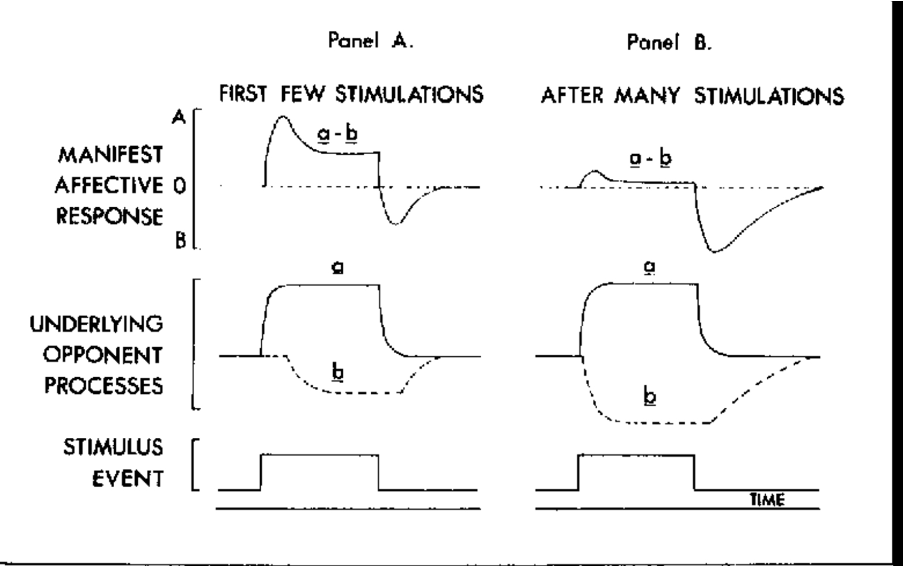
They then proposed that continued substance use is motivated by the need to avoid these negative effects.
The impaired Response Inhibition and Salience Attribution (iRISA) syndrome model highlights the important role of the Pre-Frontal Cortex (PFC) in moderating/controlling drug-related behaviours eg intoxication craving etc. The dorsal (towards the back) PFC subregions handle higher-order control ie “cold” processes and the ventral (towards the front) PFC subregions handle more automatic, emotion-related “hot” processes.
The iRISA model proposes that intoxication is accompanied by increased dopamine levels in frontal regions as well as activation in the PFC and anterior cingulate gyrus.
Drug craving – a conditioned response to drugs that involves memory processes – is also suggested to be associated with activation in the orbitofrontal and anterior cingulate cortices. Finally, drug withdrawal symptoms are thought to be the result of disruptions/negative changes in frontal cortical circuits that underlie the release of neurotransmitters such as dopamine, serotonin and corticotropin-releasing factors. Whereas PFC activation underlies craving, withdrawal is suggested to be due to deactivation and malfunction of the PFC.
During intoxication and bingeing, higher-order non-drug-related cognitive functions (eg self-control) are suppressed by increased input from the regions that regulate drug-related, “hot” functions (ie impulsive behaviour). Thus, attention narrows to focus on drug-related cues over all other reinforcers, causing impulsivity to further increase and basic emotions – such as fear, anger or love – are unrestrained. The result is that automatic, stimulus-driven behaviors, such as compulsive drug consumption, predominate.
The cue-elicited craving model (Kalivas and Volkow 2005) proposes using neuroimaging studies that substance-related cues (eg seeing someone smoking a cigarette if a smoker) induce the same neurochemical and behavioral responses as the substance itself and that craving for these substances occurs as a result of the activation within the reward circuitry following a cue.

