
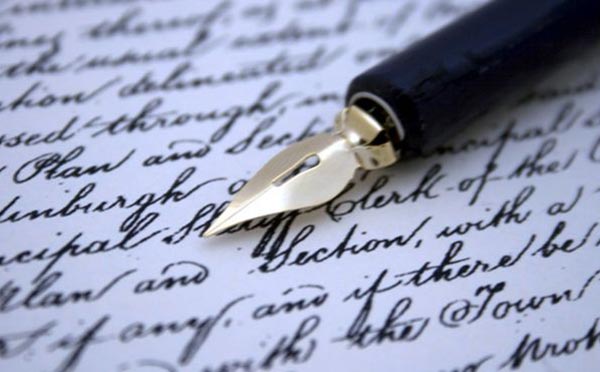

Of all the people I could ask to define for me what graphology is, an interestingly large percentage would say either one of three things – “useless”, “pretty handwriting”, or “sorry?”. Of those who could answer correctly, “the study of handwriting”, very few would actually know very much about it at all, which is exactly what I intend to rectify in this article.
Graphology as a concept, which is split into many branches, is believed first to have been conceived in 1622 in Camillo Baldi’s experiments in his book ‘Treated how, by a letter missive, one recognises the writer’s nature and qualities’. It is however considered a pseudoscience as its methods are, while thoroughly researched scientifically, not scientifically proven, and certain conclusions do bring up varying degrees of uncertainty about them. Instead, it is recognised as more of a forensic pattern-based science, and is gradually becoming more widely accepted in court and forensic examinations as a means of offering reliable evidence. Graphology works by thinking of handwriting as the brain’s imprints on the page, and utilises universal concepts – common ideas and body language traits to all cultures, an experiment pioneered by anthropologist Desmond Morris. He concluded that traits with which all children are born constitute universal body language concepts; all babies express happiness, sadness, pain and pleasure in ways that are immediately and universally recognisable.
Let’s begin with a sneak peak of some handwriting traits and some questions for you to get your teeth into! To illustrate the earlier point about universal concepts, I will begin with a few (hopefully!) common sense questions!
- Which of the following two professions is more likely to possess larger handwriting?
A – Salesman
B – Mathematician
- If someone writes with heavy pressure, they will be feeling more…
A – Relaxed
B – Angry
- Where on a page would you expect an introvert to write their signature?
A – The very middle
B – In one of the corners
I trust many of you would have answered A,B,B…
Trait 1: Size
As a general rule, the larger the writing, the more sociable and extroverted the person is.
Trait 2: Legibility & Structure
Legibility shows several things on its own – more specific deductions must be reached combined with other traits. Higher legibility either shows a person’s ability to communicate effectively or perfectionist tendencies (specifically outward, appearance-based perfection seeking in this case), and lower legibility shows that either someone may be lying, has difficulties concentrating or that they upset or angry.
Structure is slightly different to legibility; someone’s handwriting may be legible but structural all over the place, maybe something like this:
A good structure (by which I mean well-formed and consistent spacing, letters, sizes and pressure) indicates an organised individual and, especially if the writing is small, a tight structure shows the ability to concentrate on small details for long periods of time.
Trait 3: ‘Zones’
Graphological ‘zones’ use Sigmund Freud’s well-known theory of there existing within us an id, ego and a superego, with the id the part of us which accounts for base desires and instincts, such as pleasure, success, reproduction and survival. The ego represents one’s daily life and the self, while the superego is the conscience, the realm of the mind, representing philosophy, religion, fantasy and ideas. Nicely, they fit into the ‘Lower zone’, ‘Middle zone’ and ‘Upper zone’ respectively.
What does a dominating ‘Lower zone’ mean?
This indicates that someone is caught up in the material or physical aspects of life, whether that be money, physical appearance or health. Interestingly, bodybuilders tend to have larger lower zones than the standard person due to their obsession over their physical appearance.
What does a dominating ‘Middle zone’ mean?
The most obvious to understand, also in many ways a universal concept, is that a large ‘Middle zone’ is associated with childishness. It indicates that the person in question tends to be quite immature and egotistical.
What does a dominating ‘Upper zone’ mean?
This trait suggests that someone who writes like this has their head up in the clouds, living in a fantasy world. They may also be a little top heavy, full of ideas with little basis for them, and they are theoretical over practical.
Trait 4: ‘Stabbed Ovals’
An intriguing one. They look like this:
Unstabbed: Stabbed:
Ovals that are frequently stabbed are in the letters ‘a’, ‘e’, ‘o’, ‘g’, ‘d’ and ‘b’/
People who consistently write like this are often more secretive, and those who normally don’t stab their ovals but do all of a sudden in a sentence may be lying about the thing they said.
Trait 5: ‘Garlands’, ‘Arcades’ and ‘Angulars’
These concern joining letters. A ‘garland’ (the most common) is an underhand stroke; an ‘arcade’ is an overhand stroke, and an ‘angular’ is more like an angle than a stroke.
‘Garland’: ‘Arcade’: ‘Angular’:
Using ‘garlands’ means the writer is generally friendly and sociable. Using ‘arcades’ shows a desire to control, cover up or hide something, and using ‘angulars’ indicates aggression and that the writer is competitive and stern.
Quiz!
Now a quick quiz to test your new knowledge!
- Who would probably be a better friend?
A –
B –
- Who just loves gossiping?
A –
B –
- Imagine you’re a graphologist and you have just received a call from the police. They want to know who of their two suspects, Tom and Harry, is lying and they have given you these statements from them.
All the money from the local estate agents’ business account has been embezzled. All the police know is that both could have stolen the money and neither have solid alibis. You told them (a classic graphologist’s trick!) that the suspects should both end their account of what happened with a clear sentence saying, ‘I did not steal the money.’
Find out who is guilty.
A – Tom’s Statement:
B – Harry
Answers & Explanations:
1 – B
The use of stabbed ovals, arcades and a dominating middle zone would suggest that person B is not being genuine – they are actually secretive and self-centred.
2 – A
The giveaway is the tall ‘l’ and short loops on the ‘g’ – this excessive ‘Upper zone’ bias shows person A loves theorising and discussing things.
3 – B
A harder question that utilised all the traits we’ve seen today and some concepts I left for you to figure out for yourself. Tom is more introverted, but remains focussed and consistent in his writing, with unstabbed ovals and nice garlands. Harry however struggles more. Despite the fact he is more sociable and extroverted, he breaks down towards the end under the pressure of being meticulously examined by you! He leaves large gaps before ‘14:00’ and ‘the money’, which shows he is thinking about what to say. These unusual gaps indicate deception. Additionally, his larger lower and upper zones suggest that he prioritises material things, like money, more than Tom, and that he is more of a dreamer, more likely to plan the perfect theft. He then introduces stabbed ovals and arcades to his last sentence, and ultimately crumbles. His ‘had been stolen’ drops significantly, slanting downwards, showing his negative feelings towards what he was writing, and he nearly reaches the very bottom of the page, highlighting his delaying the inevitable. He knew you’d catch him!
Well done, detective!
I hope through this article you have enjoyed getting an insight into graphology and are keen to use or find out more about it! I will end with a quote about the power of this pseudoscience.
“No one can get out of his own skin. We act as our psychological past, i.e., as our cerebral organisation dictates. For this reason, we are bound to expose ourselves in the association experiment in exactly the same way as we do in our own handwriting.”
C.G. Jung, 1906

