
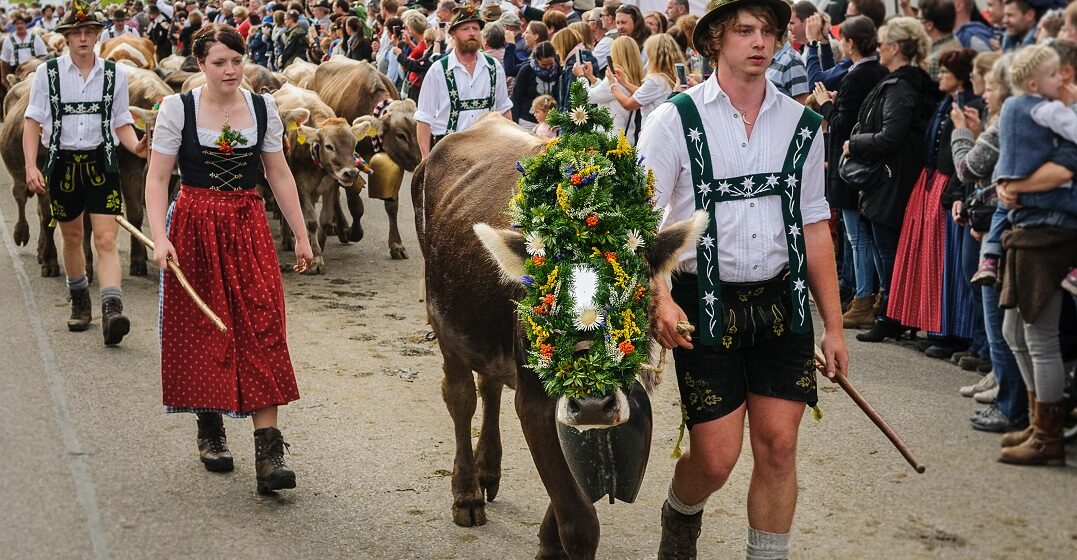

Traditions have always been an integral part of any society, and this article is here to provide psychological and sociological explanations as to why we as humans form them, and why we maintain them through the two academic disciplines of Psychology and Sociology. The psychological lens is more analytical and scientifically comprised as opposed to the latter which aims holistically scrutinise society as a whole, through various perspectives. In Psychology we will be exploring the mechanisms of conformity and memory; in sociology we will look at what Functionalists, Interactionists and Conflict Theorists have to say about these observances.
Psychology is a fascinating enigma that allows us to make quantitative, analytical judgements on people’s minds and their behaviour. The ventromedial prefrontal cortex and its streams are areas of the brain responsible for long-term memories and the formation of perceptions about certain things, such as opinions on contemporary issues. Other theories that appear to encompass traditions are social influence and cognitive biases, which we will also cover in this section of the article.
Social influence is a valid theory to explain why people follow the trends of a society. Conformity is when people follow a tradition, most commonly in the context of a collective habit we have Internalisation, where someone privately agrees with the intent of a tradition and will follow it as a consequence. For instance, a student that cohabitates with another student that is vegetarian, living for a substantial amount of time can influence the former student to internalise vegetarianism, as they have not only been around with a vegetarian, but they too also agree with the reasons for not eating meat, and the benefits of a plant-based diet.
An experiment that laid the foundation of Social Influence was Asch (1951), where a group of “confederates” and an innocent participant were shown a card with a line on it, and three more lines titled “A”, “B” and “C”, where the participants were instructed to name the line that is the closest to length with the original line, and the true answer was “C”. The “confederates” claimed “A” was the correct answer and the innocent participant was conforming to the majority by saying “A”. 50 men were the sample size here; and each had three trials with the group. It had been concluded that approximately ⅓ of the participants had said “A” all three times, and the vast majority of the 50 had said “A” at least once.

The cards on the right show the lines that were present in the experiment.
Tradition relates here as there can be a parallel drawn between the two, when a lot of people follow a certain trend, and it can become more appealing to others, as the number of people involved increase. If the tradition is successful, the tradition will last a long time as it has stood the test of time and people are starting to internalise because it has a positive influence on others. The experiment in itself does have a high internal validity, as the claim supports the hypothesis, but there is a low ecological validity, which just means that psychologists aren’t sure that this test can be applied to daily life settings, since the test is artificial and fabricated in a non-authentic setting.
The concept of our Memory could be applied to the concept that is tradition, as the theory of a Memory Bias could be simultaneously intertwined with Short and Long-Term Memory models to formulate a response. Below is the Multi-Store Memory Model, by Atkinson and Shiffrin.
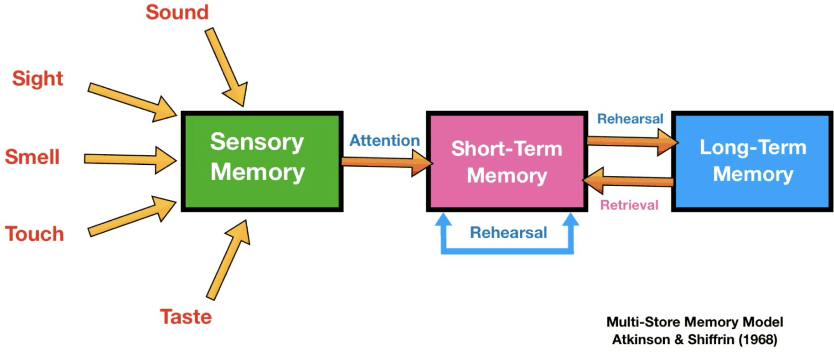
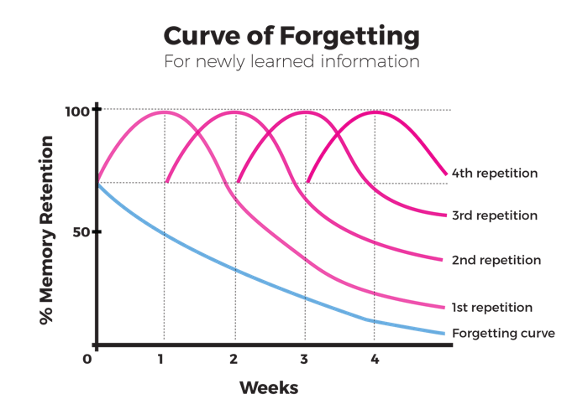
To put this into practice, this model will be applied to a classroom setting. Visual learners see information on a whiteboard, textbook etc. and record this information in their head. As their hippocampus processes this, it will go into the Short-Term memory store if this piece of information isn’t relevant to the learner, the learner isn’t particularly interested in this information or the learner isn’t focused. If the information appeals to the learner, or the learner simply has a higher skill of memory, the lesson goes to the long-term store. The process of revision is key here as revision is when information from the short-term memory is ‘rehearsed’ over and over via active recall or flashcards and put into the long term memory store, ready for ‘retrieval’ during examinations. See below the curve of forgetting which demonstrates how spaced repetition works.
When talking about tradition, they mostly appeal to the observers, so they are immediately put into the long-term memory store as ‘memories’ as there is a lot of attention drawn into them. Festivals in particular require all senses to co-operate which fastens the memorisation process. Let us scrutinise more the aspect of the ‘appeal’ of traditions or information in the context of psychology. Associations come along with any events as there is often an interplay of emotions, resulting in a high secretion of neurotransmitters like serotonin or dopamine. These chemicals allow the amygdala, a small gland in the brain, to prioritise this memory for the hippocampus to consolidate faster. Otherwise, cognitive biases can play a key role in memory forming since people have their own experiences to base their opinion on a tradition for, since the first impression is always the most important, like the Primacy Bias, which relies on the first sensory interactions with anything to develop a perspective.
For example, carnivals are usually abundant with joy and happiness, so a person that went to a carnival once may have a positive view of it. The repetitions that come after relying on the first instance, and the new experiences can pose alterations to those. There are oppositions to the Primacy Bias, like the Recency effect, which makes individuals compose judgements from the most recent occurrences.
In summary, the theory of social influence can be applied when understanding traditions, with limitations, as well as the memory model, which can simultaneously bring about an understanding of why humans follow them.
Sociology is an intriguing, multi-faceted social science. To those who aren’t familiar with it, sociology is the field of study of how a society, or groups of people work and the challenges and goals of social patterns that come with it; these are all explored through various perspectives such as:
Functionalism, which believes everything in a society has it’s place to form something called social cohesion – when people in a society share similar values and goals and are bought together.
Conflict Theorists such as Marxists and Feminists focus on the flaws and inequalities of society, experienced by a certain group of people, and what can be done to reduce them. Interactionists focus on just the interactions between people in society and what are the effects of positive and negative interactions (e.g labelling and self-fulfilling prophecies).
To summarise, Functionalists are optimistic and believe in value consensus, Conflict Theorists are generally pessimistic, and Interactionists are placed in the middle ground of those two realms.
The Functionalist perspective views traditions positively, as they form social cohesion. inherently common examples include innocuous yearly barbecues, or even religious traditions as they reinforce religion to its followers through a unitive angle. The most known research has been done on the latter; so here tradition will be scrutinised via the vehicle that is religion, as it falls under the umbrella of ’faith’. Emile Durkheim argued that religion serves 4 functions: Discipline, Cohesion, Vitalising and Euphoric. The function of Vitalising appears the most related to traditions as Durkheim argued that religious belief maintained traditions, ensuring that the values that are passed down from generation to generation are kept vital and at the heart of the society. Other sociologists like Robert Bellah talked about the role of gratifying; how showing appreciation for a culture/subculture or movement was cohesive.
The example he used was ‘Americanism’ and how the American Dream became a smoldering pride for many western fanatics, even among the most culturally secular ones. The criticisms that arise from both case studies is that religion or traditions has become oversimplified and an ‘opium for the masses’. Modern theologians and sociologists have thought of religious traditions and secular traditions to be more beneficial in smaller communities, like Martha Nussbaum who argued that religion, when becoming a core part of a state can lessen the value of the faith and when kept out, freedom is ensured for all people of all religions. Functionalists have a positive view of traditions but tend to generalise traditions for the same functions, rather than allowing fluidity within them.
Which brings us to our next enquiry, what do Conflict Theorists believe about traditions? Marx argued that the passing down of culture helps to reproduce social class stratification, and the needs of the many are sacrificed for the benefits of the few (Liberation Theology). Radical Feminists argue that tradition and the patriarchy is maintained as women still continue to work the triple shift (Ann Oakley) in the form of an amalgamation of paid labour, housework and emotional work. The main criticism here is that they dismiss the positive aspects of tradition, such as the increase of the quality of life and HDI rankings. But the secondary criticism is that their argument appears to be invalidated by countries, states or communities where there is seldom discrimination or a seldom divide between any one of CAGES (class, age, gender, ethnicity, sexuality). Examples here include The Netherlands, Belgium and Denmark.
It is important to note that traditions or observances are also present in one group of CAGES, such as Pride Month within queer people and allies of LGBTQIA+, which promote solidarity to help fight discrimination and eliminate social stigmas. Traditions are also becoming more inclusive and diverse for everyone, like the introduction of a Bat Mitzvah for girls in the early 20th century, to accompany the male counterpart of a Bar Mitzvah. Conflict theorists therefore hold a negative view of traditions, however they dismiss the positive aspects of it which weakens their argument. Cultural Feminists on the other hand present the essentialist argument that femininity is a core part of traditions and when represented well, not just within women but when anyone is in touch with their feminine side it can build a more harmonious world.
Interactionists argue that culture/religions are constructed and spread by the individual, and not a society. Labelling is a key aspect of maintaining an identity since people take on roles within a society to help maintain it’s function (e.g Choristers and Clergy in a church are different but important). A self-fulfilling prophecy is a process in which a label enables an individual to grow towards that label in its fullest potential, like a gifted child being called “gifted” allows a manifestation of potential in that child, and hence encourages an expansion of intellect. We can apply this to any traditions, like the tradition of a Postpartum mother in South Korea, who has the label of ‘Postpartum’ and is encouraged to engage in the norms of such, like eating Seaweed Soup which is the custom there. Here the criticism is that labels are too deterministic, as Mary Fuller believes that a label is a force rather than a prompt, and people may feel too pressured in a label, or that labels allow no adaptation for those involved. There are some counterarguments that can be used here, for instance the idea of a colourful funeral or a unique wedding where a bride’s gown is not white. Interactionists therefore argue labels are architects of a tradition, along with an individual, although they may be deterministic at times.
In conclusion, Psychology views traditions as constructions of Social Influence, Memory and cognitive biases like the Primacy Bias. Sociology views traditions differently through the exploration of different perspectives, like Functionalism on the importance of traditions for social cohesion, Conflict theories on the flaws and solidarity of traditions within social groups, and Interactionists on the labelling aspects.

