


Imagine you’re stuck on an assignment, running late for a lesson, and your phone just notified you of another firefly task which you know you can’t do. Your heart races, your palms sweat, and your mind conjures up a thousand ways this day could get worse. Well, I think we’ve all experienced some form of this anxiety, and this is what we call stress!
At its simplest level, stress is the body’s response to any demand or threat; it’s that sense you have when you’re worried or fearful. Over the decades, it evolved from a simple picture produced by Hans Selye – the father of modern stress studies – in the 1930s. His General Adaptation Syndrome (GAS) consisted of three phases: (i) the alarm phase, (ii) the phase of adaptation and (iii) the phase of exhaustion. His work initiated the discipline of neuroendocrinology, which now deciphers stress through the detailed symphony (or even discord!) of hormones and neurotransmitters, underlying all manners of stress.
Today, we distinguish between acute stress, an immediate yet ephemeral response to a perceived tension, and chronic stress, a prolonged state of tension that exerts deleterious effects on the body over time. Stress can also come in the form of eustress, a beneficial and motivating force, or distress, a detrimental and overwhelming experience.
The burgeoning field of psychoneuroimmunology has expanded this understanding by showing the ways in which immune function can be deeply affected by stress. These studies demonstrate that chronic stress can significantly impair immune responses and heighten susceptibility to various illnesses. So, while your prehistoric ancestors needed stress to thwart and survive saber-toothed tiger attacks, today’s ‘tiger’ might just be your inbox – and, as it turns out, your immune system is equally unimpressed by both.
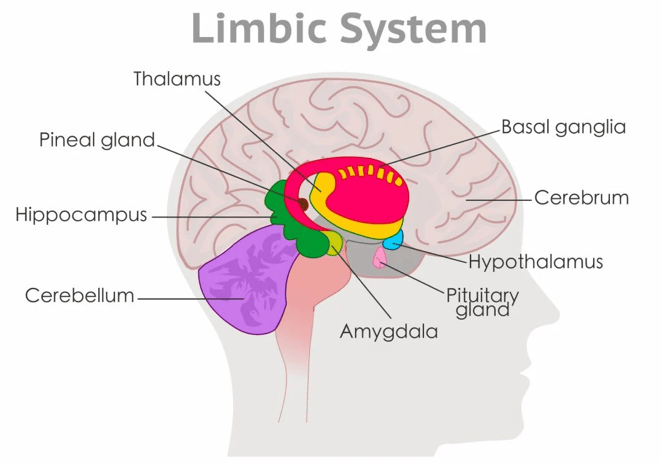
As it will be pivotal to future discussion, we should recognise the structure of the brain and how different parts impact stress response. At the core of our “animal brain” lies the amygdala, a small, almond-shaped region that triggers the “fight or flight” response”. This primitive part of the brain swiftly reacts to perceived threats, preparing the body for immediate action. In contrast, the cerebral cortex, particularly the prefrontal cortex, represents the “thinking” brain that is responsible for higher-order functions like reasoning, planning, and decision-making. While the amygdala reacts with primal urgency, the cerebral cortex processes situations more rapidly, helping to manage and mitigate stress responses more thoroughly and perceptively.
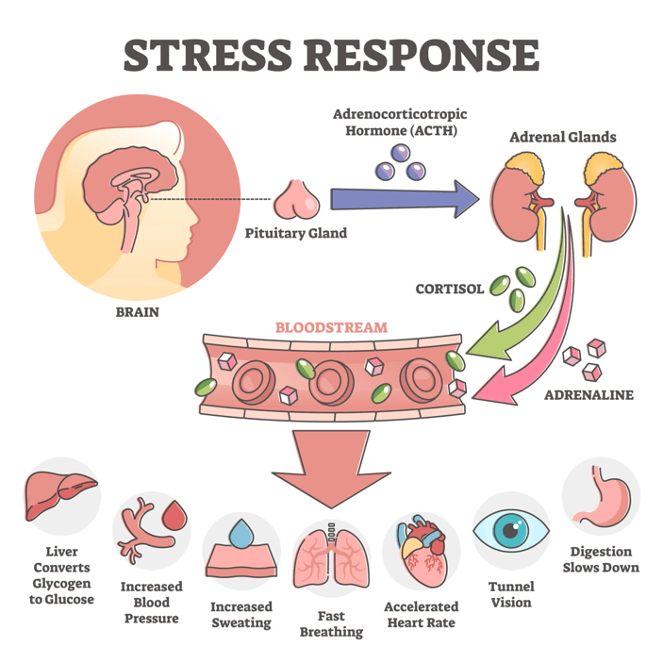
Although the technical and biological underpinnings may seem a drag, it is something well worth getting into. Central to our stress response is the Hypothalamic-Pituitary-Adrenal (HPA) axis, a dynamic trio critical to mediating the release of cortisol and regulating our stress response.
When we encounter a stressor – whether it’s a looming deadline, trials, or an unexpected threat – the hypothalamus, a small but mighty region at the base of the brain, (having been alerted by the amygdala), initiates the process by unhanding corticotropin-releasing hormone (CRH). This hormone travels through the pituitary gland, prompting it to secrete adrenocorticotropic hormone (ACTH); which then journeys through the bloodstream to adrenal glands, located atop the kidneys, stimulating them to release cortisol.
For those of you wondering: what is a hormone? Let me try to break it down simply for you. Hormones are chemicals that coordinate different functions by carrying messages through your blood to your organs, muscles, skin and other tissues. A hormone will only act on your body if it “fits” – if the cells in the target tissue have receptors that receive the message of the hormone. Through the communication of either two endocrine glands or an endocrine gland and a target organ, hormones can control bodily processes, such as metabolism, reproduction and mood, and this is why they are so crucial to mediating stress.
While cortisol is the headliner of the stress hormone ensemble, it’s not a solo act; it even has a dual role. In the short term, it’s a hero. It mobilises energy by increasing glucose availability and, by increasing blood sugar levels and boosting energy production, ensures that we’re ready to tackle ongoing challenges. Cortisol also puts non-essential functions like digestion, reproduction and immunity on the back burner – because who needs a functioning digestive system when you’re in constant fight-or-flight mode, for example, fighting tigers?
However, chronic stress turns cortisol into a villain as prolonged exposure impairs cognitive function, represses the immune system, and packs on abdominal fat. It’s like having a smoke alarm that never stops blaring – helpful in a fire, but irritating and irksome if it never shuts off.
Fortunately, cortisol regulates its own production by using a negative feedback loop to signal the hypothalamus and pituitary gland to reduce the release of CRH and ACTH once cortisol levels are too high. This mechanism acts like an internal thermostat, preventing cortisol levels from spiraling out of control and ensuring the stress response remains balanced.
On top of this interplay, adrenaline (epinephrine) and noradrenaline (norepinephrine) are the sprinters, acting as rapid responders in stress situations. These catecholamines, released almost instantly by the adrenal medulla, ramp up heart rate, blood pressure, and energy supplies. They are the reason we can act so quickly in emergencies. Yet still, sustained high levels can lead to cardiovascular problems and anxiety disorders.
Stress, as it turns out, doesn’t just affect our hormone levels; it also disrupts our brain’s neurochemical balance.
It seems appropriate, now that I am about to give you some examples, to elucidate what is meant by a neurotransmitter. Neurotransmitters are endogenous chemicals – originating from within the organism – that allow neurons (nerve cells) to communicate with each other throughout the body. They enable the body to provide a variety of functions, through the process of chemical synaptic transmission, such as heartbeat, digestion, senses and breathing.
An example is serotonin, often dubbed the “feel-good” neurotransmitter, responsible for mood regulation. When stress hits, it’s like someone dimming serotonin’s lights, casting us into a forlorn gloominess, which may even be regarded as depression. Chronic stress, the form of stress which seems the root of all problems, can disrupt serotonergic pathways, leading to mood disorders like anxiety and depression.
Dopamine is another example and serves as the brains “reward” system that typically motivates and brings pleasure. Stress can interfere with how dopamine’s produced and how sensitive its receptors are causing even enjoyable activities to feel less rewarding and possibly leading to burnout.
Meanwhile, Gamma-Aminobutyric Acid (GABA), the brain’s primary inhibitory neurotransmitter, and the last example, acts like a bouncer at a lively party, keeping excitatory signals in check. It slows down signals in your brain by blocking specific messages in your central nervous system (your brain and spinal cord), thereby producing a calming effect.
I have ambled on about the biochemical innerworkings enough now but should briefly provide you with the behavioral and psychological effects of stress – so that you know what you’re dealing with. On top of the quintessential impacts like anxiety, depression and weight gain there are more unsung short-term problems such as insomnia, aggression, exhaustion and sadness which are worth noting. Although some of these problems feel typical of human experience, being able to identify and respond to these effects as occurring out of stress can help you manage it better and feel more at ease with yourself.
In our modern day there are many pharmacological interventions which may be used as they can be quite effective. Traditionally, less risk-heavy methods of resilience and coping have revolved around mindfulness, cognitive-behavioral therapy (CBT) and environmental enrichment but when all these fail, antidepressants and anxiolytics do seem the solution. Selective serotonin reuptake inhibitors (SSRIs), for example, are known to increase serotonin levels, improving mood and anxiety symptoms. Looking into the future, novel therapies, including psychedelics, are being researched into for their potential to reset dysfunctional neural circuits and promise solutions to reduce the negative consequences of stress for all human beings.
With that all being said, we can agree that the biochemistry of stress is a complex phenomenon which we should appreciate. By unraveling the mechanisms behind stress, we can develop strategies to manage it and improve our overall well-being.
So, the next time you start to feel wearisome, whether that be revising for an oncoming trial or awaiting some life-changing result, your newfound knowledge of hormones and neurotransmitters (that are characterising your fear) should hopefully add a little bit of comfort to your mental state!

