
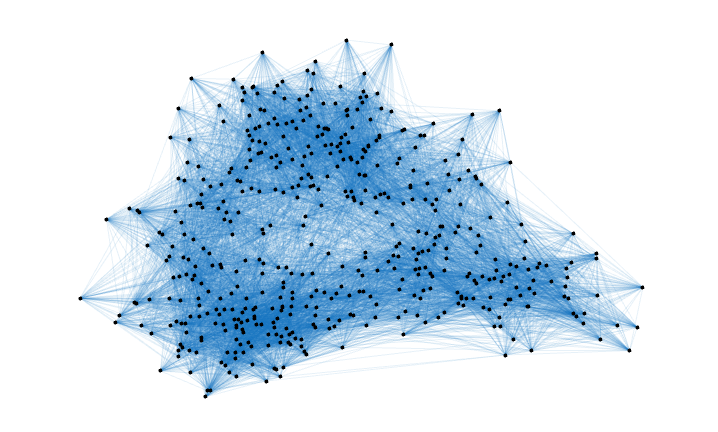
Could any two people on earth be linked by a chain of no more than six acquaintances? Social psychology and network science have allowed this seemingly fallible claim to linger in the popular imagination for almost a century. It has achieved some familiarity through John Guare’s play Six Degrees of Separation (1990) as well as through several books. On top of being an incredibly interesting insight into how surprisingly interconnected the world is, it also gives answers for how complex systems organise, the way information spreads and even how human psychology interprets social distance.
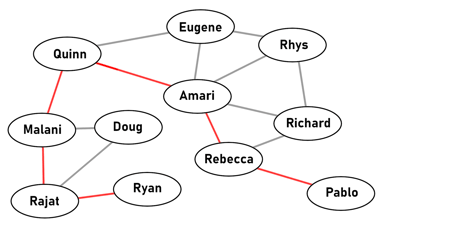
The bridge between sociology, psychology and mathematics in this case is the Watts-Strogatz model. It established the understanding that real-world networks are not chaotic entanglements but rather groups of local circles linked by a few long-distance connections. This slight distinction explains how worldwide connectivity can align with local consistency, reflecting the manner in which human thought reconciles known elements with new experiences.
The Origins of “Six Degrees”
The idea of six degrees of separation is not new and can be traced back to the 1920s when Hungarian author Frigyes Karinthy suggested the modern world was “shrinking”. The idea of six degrees of separation is not new and can be traced back to the 1920s when Hungarian author Frigyes Karinthy suggested the modern world was “shrinking”.
Despite large physical distances between individuals, the growing density of human networks made actual social distance much smaller. In the following excerpt from his short story Chains (1929), we see him meddling with the very problems that fascinated later generations in the field of network theory:
“Everything returns and renews itself. The difference now is that the rate of these returns has increased, in both space and time, in an unheard-of fashion. […] Entire passages of world history are played out in a couple of years.”
Then, he describes a game within which he and his friends toy with testing the concept of connections. It is this very proposal that social psychologist Stanley Milgram later put to the test:
“Using no more than five individuals, one of whom is a personal acquaintance, he could contact the selected individual using nothing except the network of personal acquaintances.”
This test was the 1967 “small-world experiment,” wherein Milgram mailed packages to random Americans and asked them to forward them to a target person in Boston, but only through people they personally knew. The average chain length turned out to be around six (hence “six degrees”). And Milgram’s data revealed something subtler… people were not forwarding letters arbitrarily but were rather using ‘cognitive heuristics’, sending packages to friends they guessed were strongly connected or geographically closer to the target. In other terms, human participants acted like algorithms optimizing a course through an unseen network, using a mental representation of social structure to manage complexity effectively. All of this suggested a fundamental mathematical structure, which Watts and Strogatz could eventually reveal.
The Breakthrough: Watts-Strogatz (1998)
In the late 1990s, physicist Steven Strogatz and graduate student Duncan Watts aimed to develop a model that would harmonize two opposing characteristics of actual networks:
– (I) High Clustering: friends of friends generally recognized one another.
– (II) Short Path Lengths: the majority of nodes can be accessed with minimal connections.
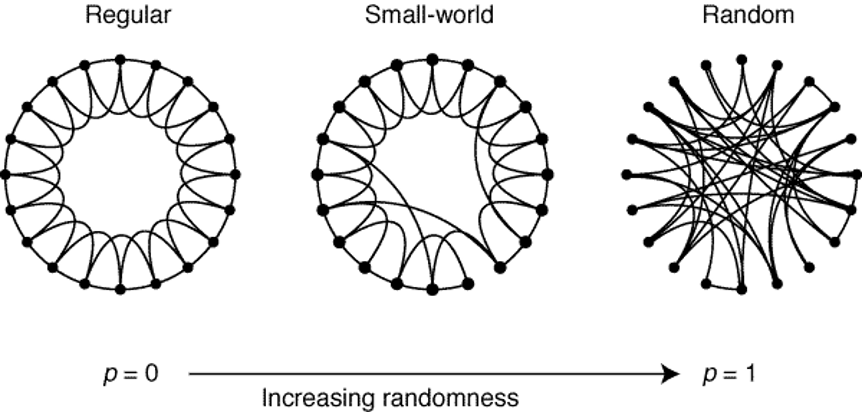
Traditional networks were not able to accomplish both tasks. A typical lattice exhibited strong clustering but lengthy paths, whereas a random network featured short paths at the expense of local structure.
Their method was straightforward. They began with a structured lattice and subsequently altered a small portion of the connections randomly. Even when a small fraction (possibly 1 or 2%) of long-distance connections was changed, it reduced the average path length, creating what they referred to as a small-world network. Consequently, these limited shortcuts preserved local order while
linking the entire network globally (similar to wormholes in the social realm). This model quantitatively assessed “six degrees” and connected various domains, demonstrating that slight randomness added to an organized system leads to significant increases in connectivity.
The major limitation is that the model produces an unrealistic degree distribution; in contrast, real networks are often scale-free networks (not uniform in degree), possessing hubs and a scale-free degree distribution. This means that such networks are better described by the preferential attachment family of models (like the Barabási-Albert one) yet these have equal shortcomings. Also, the Watts-Strogatz model implies a fixed number of nodes, so cannot be used for modelling network growth.
Small Worlds can be Found Everywhere
The introduction of this model enabled researchers to find that small-world patters emerge in an unexpectedly wide range of systems. These encompass neural networks within the brain, social media sites as well as metabolic and gene-regulatory networks found in biology.
All these structures exhibit consistent statistical proof of a high clustering coefficient (measuring local density) and a low characteristic path length (the average distance between any pair of nodes). This new understanding reshaped their perspective of our world, showing it not just as expansive and uncontrolled but as intricately connected, functioning through a few crucial links that would disrupt the system if taken away. By eliminating just a few critical nodes, an entire system can break apart, carrying serious consequences for cybersecurity, public health and social stability.
The Human Brain as a Small-World Explorer
The Watts-Strogatz model is especially relevant due to its psychological implications. Human thinking naturally leans toward small-world reasoning as we prefer close-knit groups (our communities, sports clubs etc.) but also desire a few distant connections (new experiences, new friendships etc.). These “weak connections” facilitate the flow of ideas, opportunities and innovation.
Psychologically, our minds perform a comparable balancing act. Cognitive neuroscience demonstrates that the human connectome (the wiring layout of the brain) exhibits a small-world topology, facilitating efficient information integration. Areas that focus on various tasks maintain local coherence while also being globally synergistic. Socially, this organization influences group dynamics, as tightly knit communities foster trust and common understanding, while those with excessive random connections can lead to confusion and diminished unity.
Conclusion
The small-world concept exposes a significant conflict in modern psychology. That tension lies in the idea that feeling connected might not equate to actually being connected. For instance, social media broadens our worldwide connections but can also skew our personal feelings of closeness. The same extensive connections that enhance the network’s efficiency simultaneously reduce psychological distance, causing distant views or disputes to become suddenly prominent. This clarifies why outrage, misinformation or empathy spread so quickly on the internet. Grasping this mechanism is essential for creating settings that emphasise significant (rather than merely statistical) connections.
Bassett, Danielle S, and Olaf Sporns. “Network neuroscience.” Nature neuroscience vol. 20,3 (2017): 353-364. doi:10.1038/nn.4502
Watts, D J, and S H Strogatz. “Collective dynamics of ‘small-world’ networks.” Nature vol. 393,6684 (1998): 440-2. doi:10.1038/30918
Wikipedia contributors, “Watts–Strogatz model,” Wikipedia, The Free Encyclopedia
Wikipedia contributors, “Six degrees of separation,” Wikipedia, The Free Encyclopedia
Wikipedia contributors, “Small-world experiment,” Wikipedia, The Free Encyclopedia
The Decision Lab. “Six Degrees of Seperation.” Retrieved October 31, 2025.

